
Hiking with trekking poles provides measurable benefits including reduced knee stress by up to 25%, improved balance on uneven terrain, and increased walking endurance. Pat Falvey Irish & Worldwide Adventures has guided over 2,000 trekkers across mountains worldwide, with trekking poles standard equipment on every expedition. This guide covers the benefits of hiking with trekking poles, how to choose the right pair, and practical tips for using them effectively.
Benefits of Hiking with Trekking Poles
The benefits of hiking with trekking poles extend far beyond simple walking support. Trekking poles transform hiking from a lower-body exercise into a full-body workout whilst simultaneously protecting joints and improving stability. Research shows that the benefits of hiking with trekking poles include reducing force on knees by 25% on descents and increasing calorie burn by up to 20% compared to hiking without poles.
Pat Falvey Irish & Worldwide Adventures equips all clients with trekking poles for guided Carrauntoohil hikes and international expeditions. After 30 years of leading treks across five continents, the company recognises that the benefits of hiking with trekking poles make them essential equipment rather than optional accessories.
Enhanced Endurance and Full-Body Engagement
Hiking without trekking poles engages primarily leg muscles. The benefits of hiking with trekking poles become apparent when you add arm and upper body engagement to each step. This distribution of effort across more muscle groups allows trekkers to walk further distances without experiencing the same level of fatigue concentrated in the legs.
Your arms, shoulders, and core muscles contribute to forward propulsion with each pole plant. This full-body engagement means no single muscle group becomes overwhelmed during long ascents. Trekkers on Kilimanjaro expeditions report covering 15-20 kilometres daily with less perceived exertion when using poles compared to previous treks without them.
The cardiovascular benefits of hiking with trekking poles also increase measurably. Studies indicate that oxygen consumption rises by approximately 20% when using poles correctly, translating to a more effective workout without increasing perceived difficulty.
Joint Protection and Load Distribution
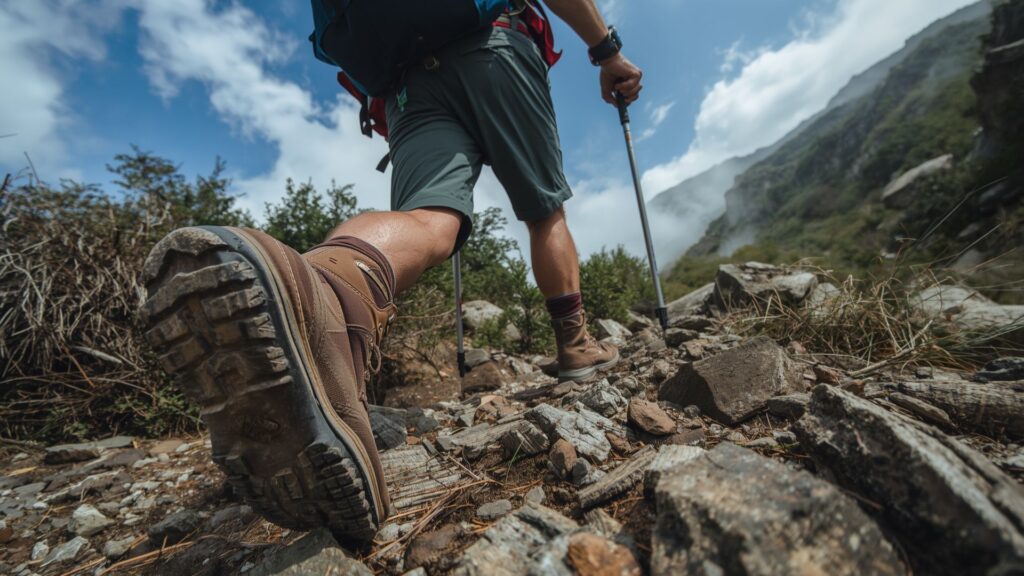
One of the most significant benefits of hiking with trekking poles involves protecting knees and ankles from repetitive impact stress. When carrying a heavy pack, each downhill step sends force equivalent to three to four times your body weight through your knee joints. Trekking poles absorb a substantial portion of this impact.
The poles function as shock absorbers, transferring load away from vulnerable joints to your arms and poles. This proves particularly valuable on steep descents where knee injuries most commonly occur. Pat Falvey’s guided groups on the Devil’s Ladder route up Carrauntoohil experience noticeably less knee discomfort when using poles throughout the 1,038-metre descent.
Ankle stability improves dramatically with pole support. On uneven terrain covered with loose rocks or scree, poles provide additional points of contact that prevent ankle rolls. Trekkers with previous ankle injuries find the benefits of hiking with trekking poles allow them to tackle challenging routes they would otherwise avoid.
Improved Rhythm and Walking Speed
Trekking poles help establish a consistent walking rhythm that naturally increases average pace over time. The regular planting motion creates a metronome effect, with each pole strike coordinating with your footfall. This rhythmic pattern reduces energy waste from irregular stride patterns and hesitation on technical terrain.
Groups using poles on Everest Base Camp treks maintain more consistent speeds across varied terrain types. The psychological benefits of hiking with trekking poles include increased confidence on challenging sections, translating directly to faster progress without increased risk.
Superior Balance on Challenging Terrain
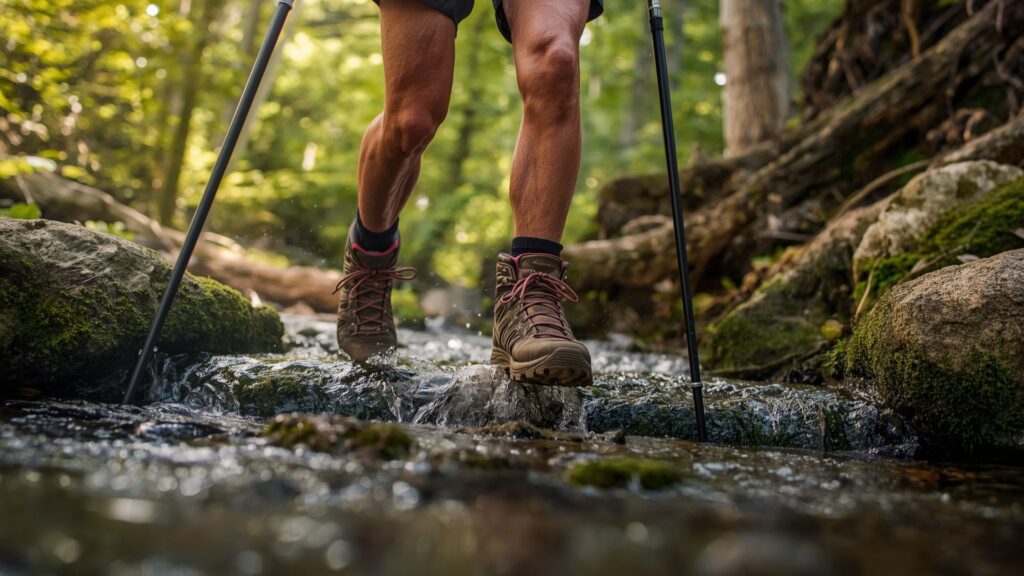
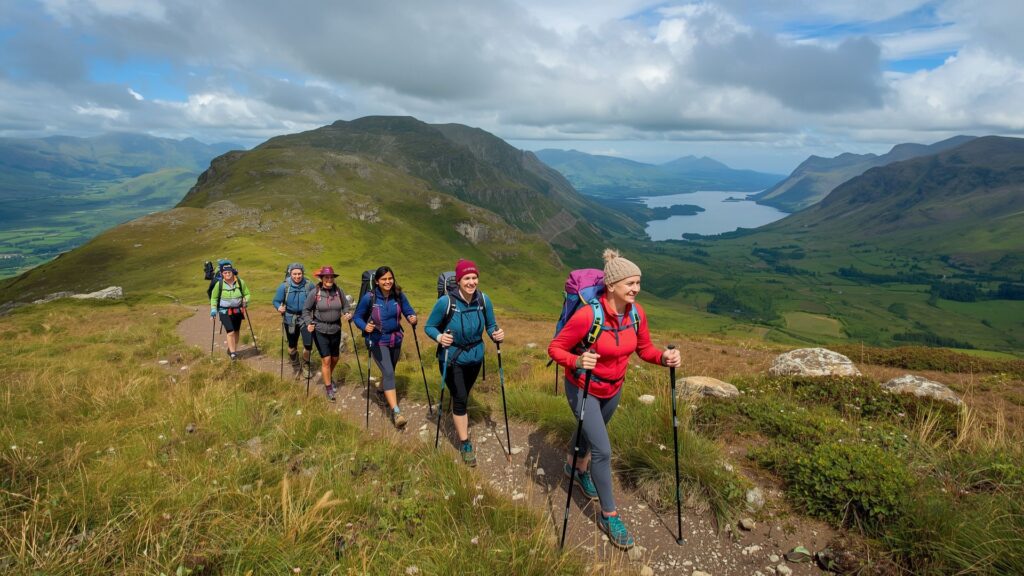
Four points of contact provide exponentially better balance than two feet alone. The benefits of hiking with trekking poles become most obvious when crossing streams, navigating snow, or traversing slippery mud. Each pole extends your base of support and offers immediate stabilization if you begin to slip.
Snow hiking requires poles for safe progress. The baskets prevent poles from punching through soft snow whilst providing secure placement for weight transfer. Winter ascents of Carrauntoohil through snow-covered gullies become manageable with proper pole technique, whereas attempting the same route without poles creates unnecessary risk.
Rocky terrain tests balance constantly as you step between boulders of varying heights and stability. Poles allow you to test rock stability before committing full weight, probe for secure footholds hidden beneath vegetation, and catch yourself during momentary imbalances.
Uphill Propulsion and Reduced Back Strain
The benefits of hiking with trekking poles include transforming your arms into additional propulsion engines on steep climbs. By pushing down and back on poles planted ahead of you, you engage arm and shoulder muscles to supplement leg power. This combined effort reduces the burden on quadriceps and calves during sustained ascents.
Climbers on Aconcagua expeditions use poles to maintain steady progress during the 6,962-metre ascent. The sustained gradients require efficient energy use, and poles provide the mechanical advantage needed to reach the summit with reserves remaining.
Heavy pack weight concentrates stress on the lower back and hips. Poles effectively reduce perceived weight by supporting part of your upper body mass. The forward lean required when carrying heavy loads can strain lumbar muscles over hours of hiking. Poles allow you to maintain a more upright posture, reducing lower back fatigue significantly.
How to Choose Trekking Poles
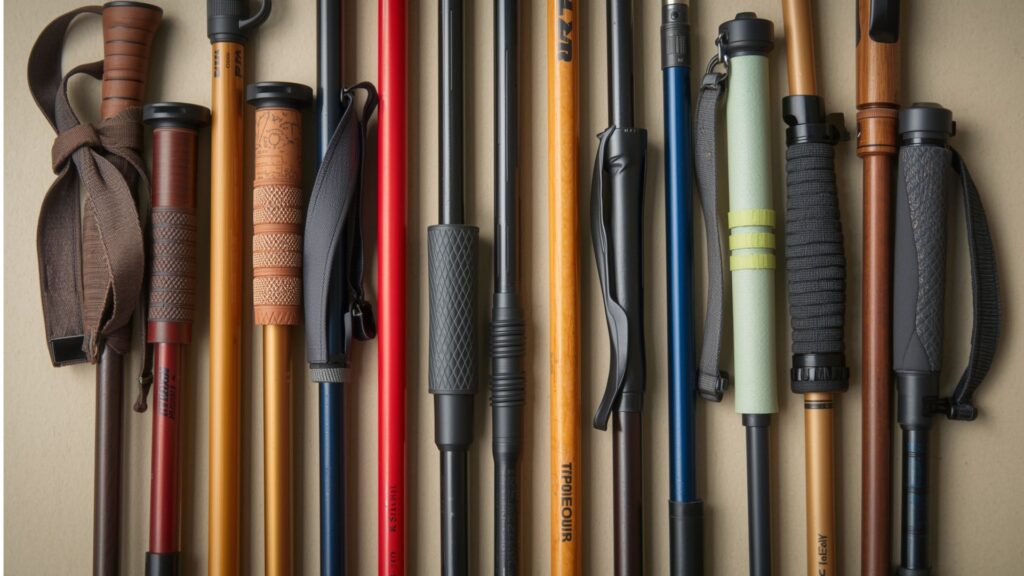
Selecting appropriate trekking poles requires evaluating several factors based on your typical hiking conditions and physical needs. The wrong poles can cause blisters, fatigue, or prove ineffective in the conditions you encounter most frequently.
Poles vs Staff: Why Two Poles Work Better
Two poles provide superior benefits compared to a single hiking staff. A single wooden staff offers limited utility, primarily on flat terrain whilst carrying minimal pack weight. Pat Falvey Irish & Worldwide Adventures recommends purchasing trekking poles sold as matched pairs.
The paired pole technique allows alternating patterns that match natural walking gaits. Your right pole plants as your left foot steps forward, creating a diagonal support pattern that feels intuitive within minutes of use. If you prefer using a single pole occasionally, strap the second pole to your pack rather than purchasing only one.
Grip Materials: Cork, Foam, and Rubber
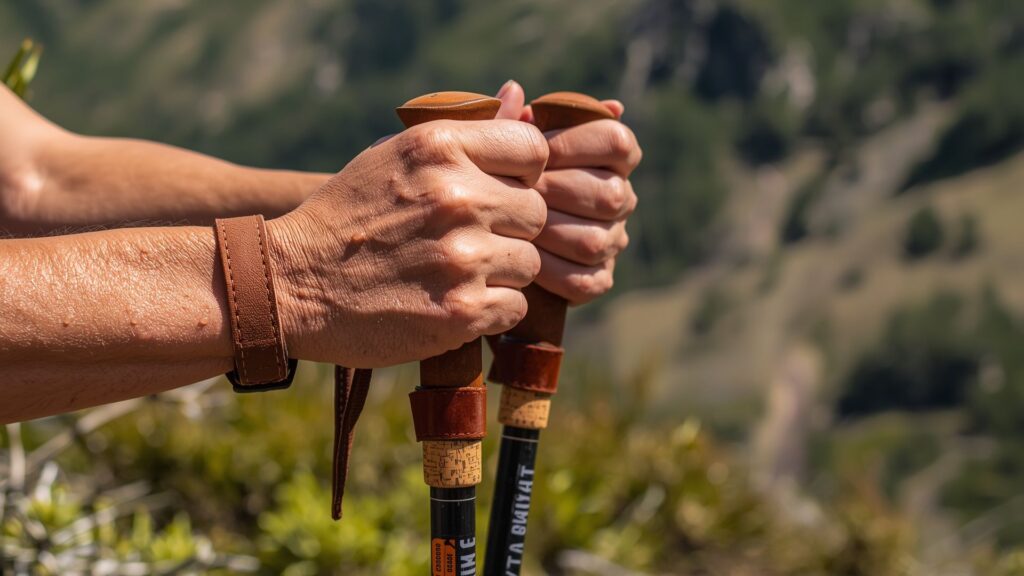
Grip material significantly affects comfort during long treks. Cork grips wick moisture away from sweaty hands whilst conforming to your hand shape over time. The natural material absorbs vibrations transmitted up the pole shaft, reducing the jarring sensation from rocks and hard ground. Cork performs well across temperature ranges and develops a personalized fit after 20-30 hours of use.
Foam grips absorb moisture but retain it rather than wicking it away. The soft material feels comfortable initially and provides good cushioning. However, foam grips can develop unpleasant odours over time if you sweat heavily during hikes.
Rubber grips insulate hands from cold, making them ideal for winter hiking in freezing conditions. However, rubber causes chafing and blistering during warm-weather hikes as it does not breathe or absorb moisture. For varied conditions, cork provides better all-round performance.
Wrist Straps: Essential for Load Transfer
Wrist straps serve a critical function beyond preventing dropped poles. Proper strap use transfers weight from your hands to your wrists and forearms, reducing grip fatigue during long descents. Quality straps feature padding and adjustable length to accommodate different hand sizes and glove thickness.
Thread your hands up through the bottom of the strap loops so the strap crosses your palm before you grip the handle. This technique allows you to push down on the strap during each pole plant without maintaining a tight grip.
Pole Material: Aluminium vs Carbon Fibre
Most trekking poles use either aluminium or carbon fibre construction. Aluminium poles cost less and bend rather than break under extreme stress. If you strike a rock forcefully or fall on your pole, aluminium typically bends, allowing you to straighten it enough to continue using it.
Carbon fibre poles weigh 50-100 grams less per pair than equivalent aluminium models. The reduced weight becomes noticeable during all-day treks where you plant poles thousands of times. Carbon fibre also dampens vibrations more effectively than aluminium. However, carbon fibre snaps rather than bends when overstressed.
For expeditions to remote locations like Island Peak and Everest Base Camp, aluminium poles provide reliability and repairability. For shorter UK and European treks where replacement poles are readily available, carbon fibre offers worthwhile weight savings.
Adjustable Length: Critical for Varied Terrain
Adjustable poles allow you to optimize length for terrain gradient. Shorten poles by 5-10 centimetres when climbing uphill to maintain comfortable arm angle and efficient pushing position. Lengthen poles by 5-10 centimetres on descents to keep your arms at proper angles whilst poles reach further down the slope ahead of you.
The adjustment mechanism must hold securely under load. A pole that slips shorter mid-stride can cause falls or create jarring impacts. Quality locking mechanisms maintain length across thousands of adjustments without degradation.
Locking Mechanisms: Lever vs Twist
External lever locks provide fast, glove-friendly adjustments. The flip-lever mechanism clamps around the pole shaft, with tension adjustable via a small screw if the lock loosens over time. You can adjust lever locks whilst wearing thick gloves, useful during winter hikes or at high altitude.
Twist locks require rotating the pole shaft to tighten or loosen an internal expansion mechanism. However, twist locks can freeze in cold conditions, jam if dirt enters the mechanism, or loosen gradually during use. Pat Falvey Irish & Worldwide Adventures has experienced both reliable and problematic versions of each locking style. Quality matters more than mechanism type.
Shock Absorption and Baskets
Shock-absorbing poles include internal springs that compress slightly with each impact, reducing jarring forces transmitted to your hands, wrists, and elbows. This feature provides measurable benefits if you have weak or previously injured ankles, knees, or hips. Hikers without joint issues may find standard poles adequate.
Baskets attach to pole tips and prevent poles from sinking into soft snow or mud. Standard small baskets work for firm ground and rocky terrain. Larger baskets measuring 10-15 centimetres in diameter become essential when hiking through snow deeper than a few centimetres. Interchangeable basket systems allow you to swap small baskets for large snow baskets based on conditions.